


After spending a year with Function Health's testing platform, I came to a conclusion that surprised me: more data does not always mean better health. Function delivers on its promise of deep, comprehensive lab testing, and through its partnership with Quest Diagnostics, getting tested is genuinely easy. But I found myself buried in numbers and short on a clear plan for what to actually do with them. This is my full, first-hand Function Health review, what it does well, where it fell short for me, what it really costs in 2026, and the alternative I switched to.
Pros
- 160+ lab tests a year, far beyond a standard physical
- Easy access through 2,000+ Quest locations
- Clinician-reviewed notes and an action plan
- Now includes AI Chat, Protocols, and a biological age score
What's Missing
- Twice-a-year testing rather than continuous tracking
- Premium add-ons like MRI and cancer screening cost extra
- Higher price for New York and New Jersey residents
- No built-in supplement delivery or prescriptions
- Function Health offers 160+ lab tests a year for $365, aiming at early detection and a fuller picture than a routine physical.
- Testing runs through Quest Diagnostics, with a first panel of 100+ markers and a follow-up of 60+ markers three to six months later.
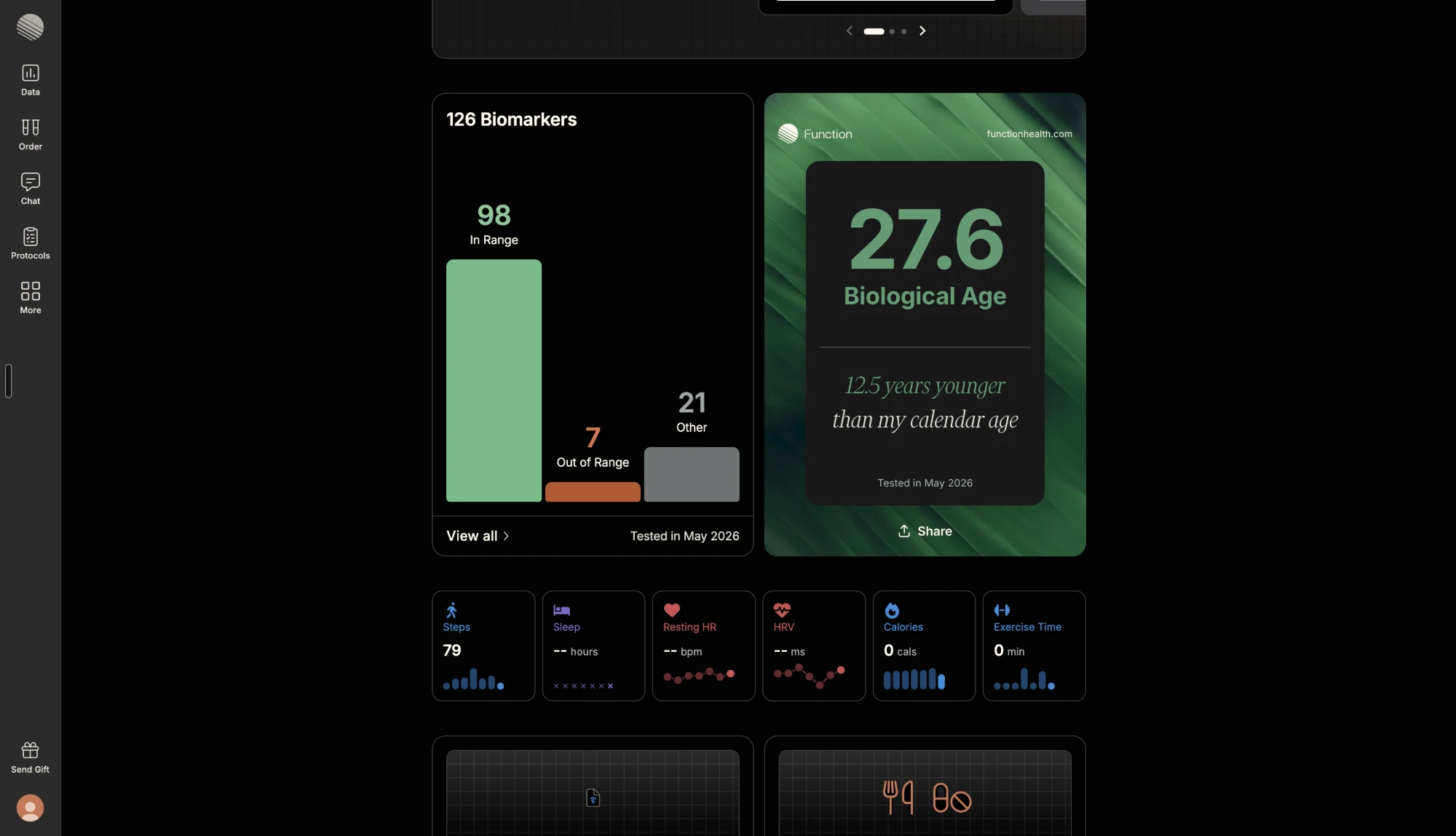
- You get clinician notes, a personalized action plan, a biological age score, and newer AI Chat and Protocols features.
- The data is genuinely deep. The main thing it does not include is the add-on layer that turns results into an ongoing, day-to-day plan.
- After my year with Function, I switched to OneTwenty for a more continuous, hands-on approach to optimization.
I switched from Function Health to OneTwenty
Function tells you what is off twice a year. OneTwenty runs a full panel and then three targeted follow-ups across the year, watches 22 daily device metrics from your wearables, builds your supplement protocol off your actual results, and connects you with prescriptions when your labs call for them, adjusting your plan every 90 days. Same Quest labs, a system that keeps working between them.
See OneTwentyWhat Is Function Health and Why I Tried It
I signed up for Function Health because I wanted more comprehensive testing than what my doctor typically ordered. Function, founded in 2022 by Dr. Mark Hyman, a leading voice in functional medicine, and tech entrepreneur Jonathan Swerdlin, promised to put real health data directly in my hands. The pitch was simple and appealing: instead of waiting for symptoms, proactively monitor the markers that routine physicals skip and catch issues early.
The platform covers 160+ lab tests across a year, spanning advanced cardiovascular markers, full thyroid and hormone panels, inflammatory markers, nutrient status, metabolic health, and more. Through Quest Diagnostics you can book a draw at one of more than 2,000 locations nationwide without needing a doctor's order. For someone who wanted to understand their body at a deeper level, it was an easy yes.
My Testing Experience with Function Health
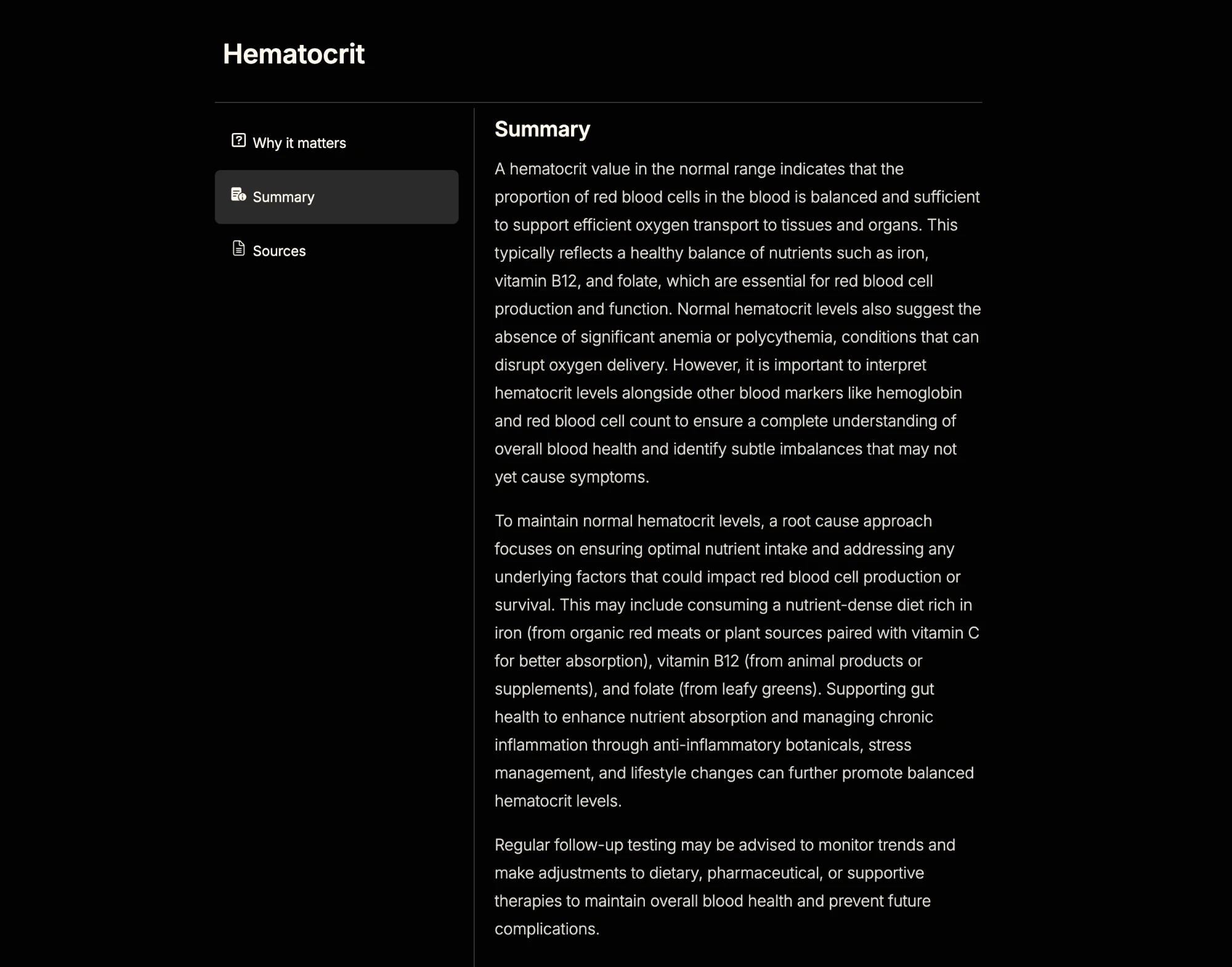
The process was smooth. I booked online and went to Quest, where the blood was drawn and processed by CLIA-certified labs. Results landed in the portal within 7 to 10 business days, with a fuller clinician summary a couple of weeks later.
- Convenient draws: Scheduled through the Function portal at a nearby Quest location, no doctor referral needed.
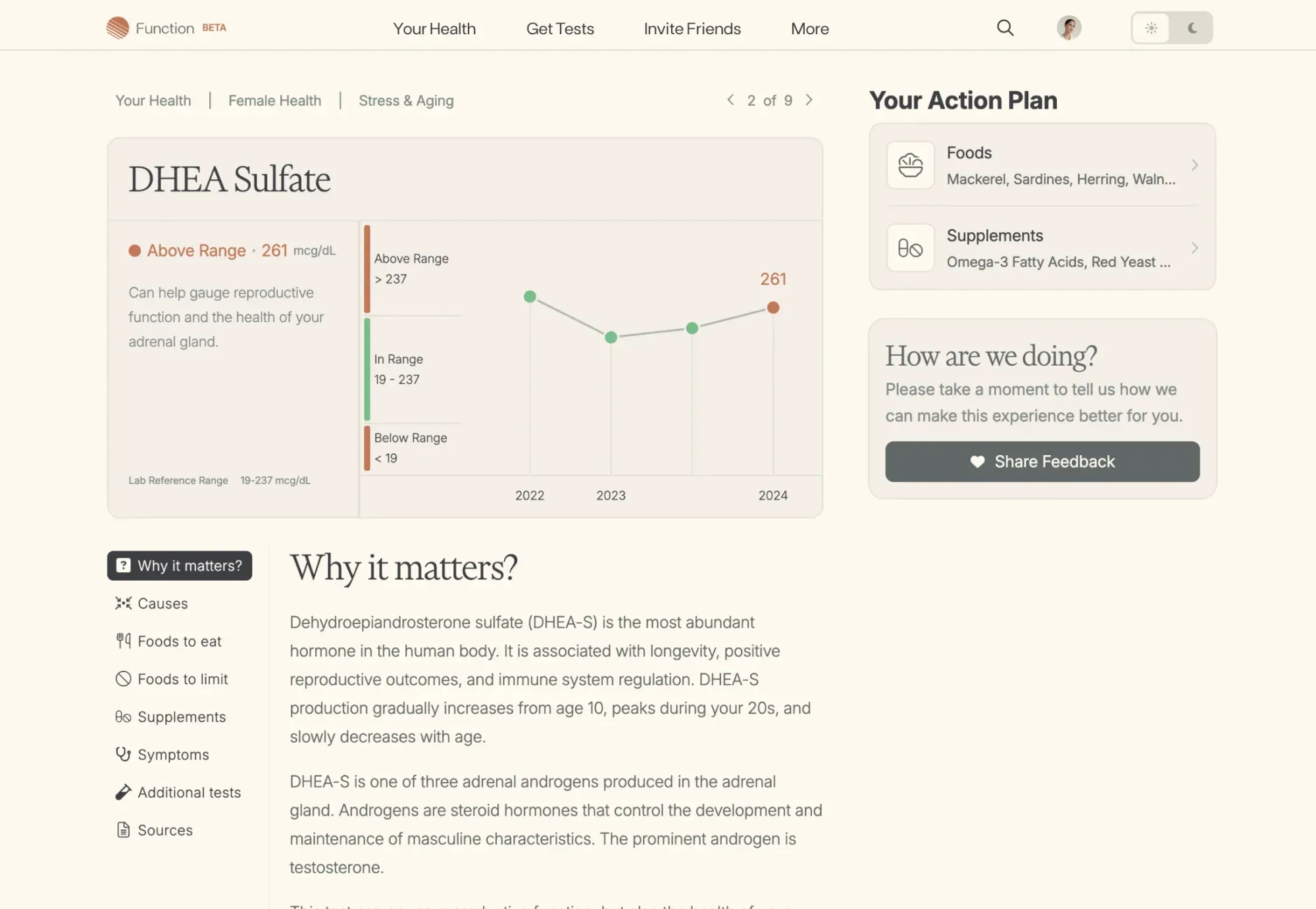
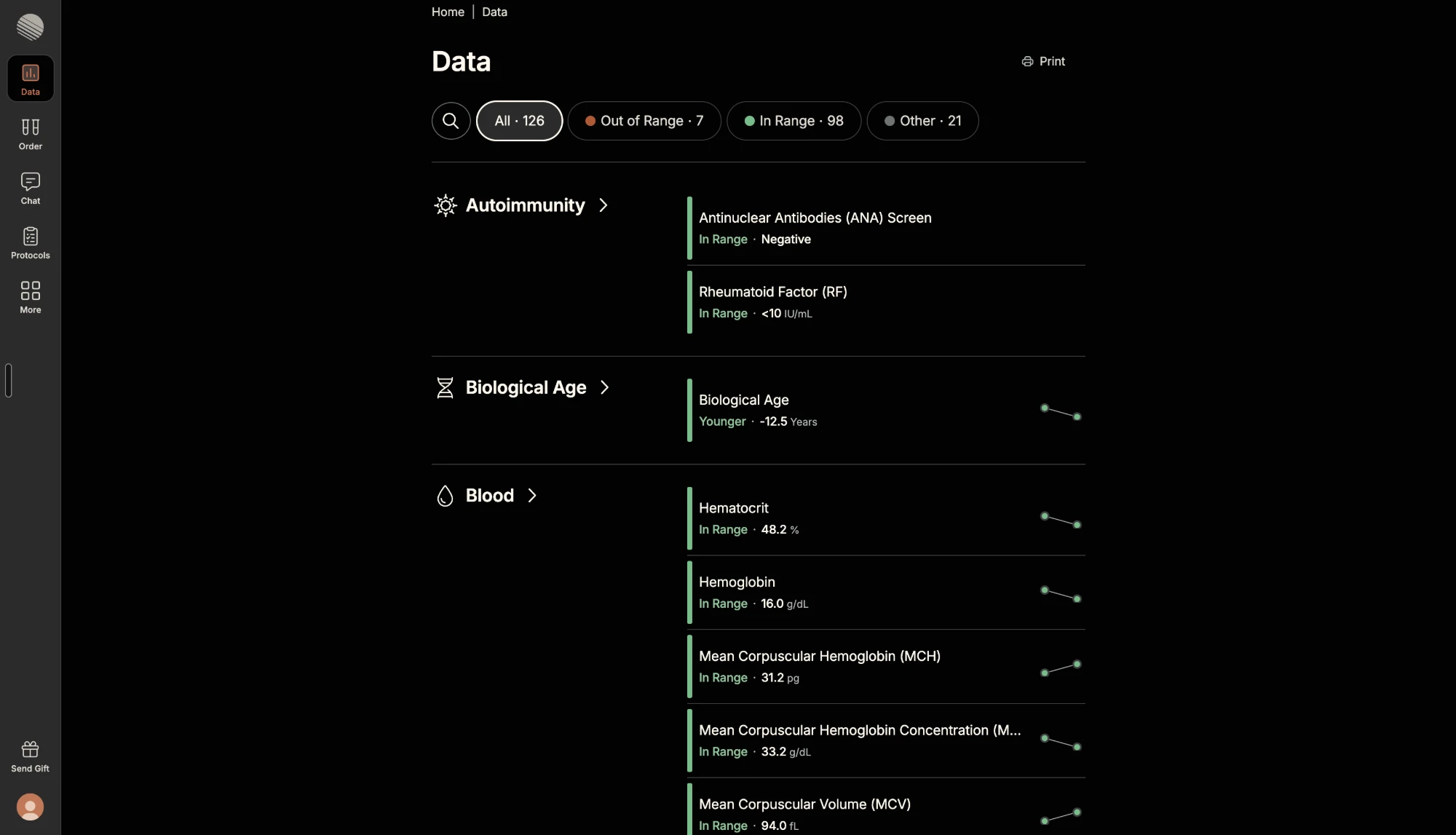
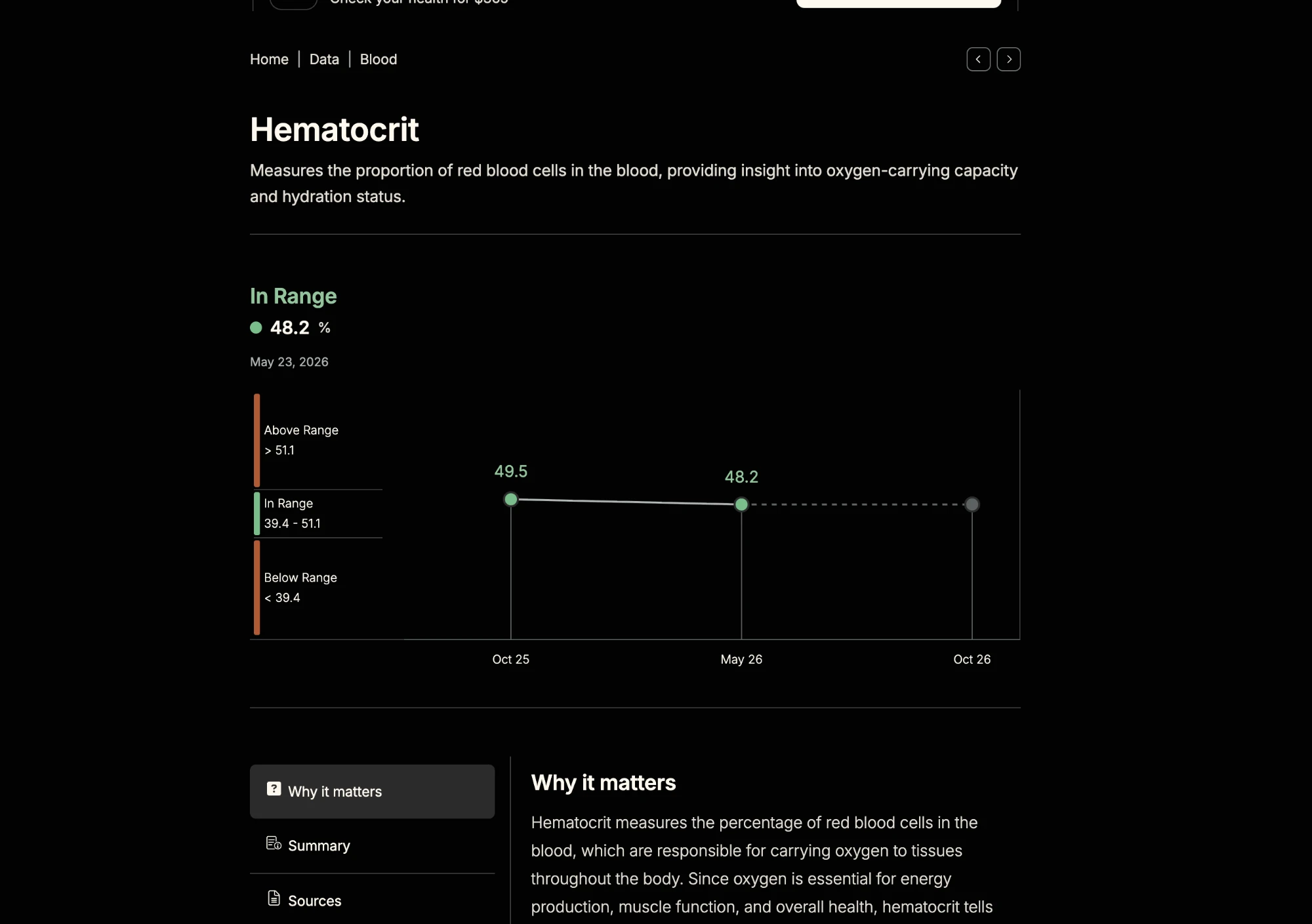
- Clean dashboard: Results sorted into In Range, Out of Range and Other, color-coded green, orange and grey, with a "why it matters" write-up on every marker.
- Trend tracking: Graphs showing how markers moved between draws, so you can see whether your changes are working.
- Clinician summary: Context on what abnormal results might mean, plus diet, supplement, and lifestyle suggestions.
If anything urgent shows up, a physician calls you directly. For someone who tends to worry about health data, that safety net was reassuring and is a genuine strength of the platform.
What I Liked About Function Health
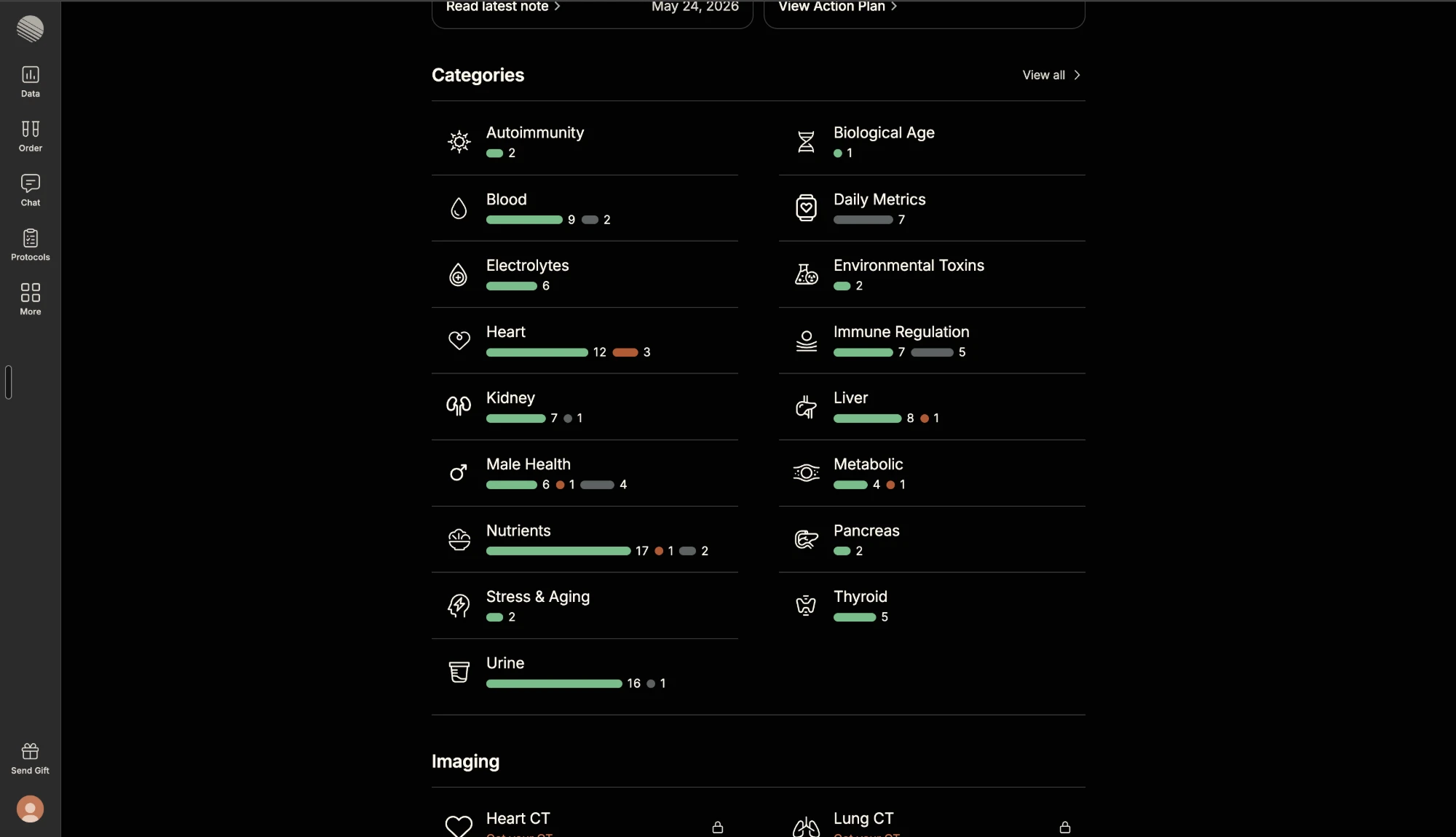
Plenty about Function is genuinely well done, and it has only improved since launch.
- Comprehensive coverage: 160+ markers a year across heart, thyroid, hormones, inflammation, nutrients, and metabolic health, far more than a standard annual physical.
- Clinician interpretation: The summaries go beyond raw numbers, connecting markers and offering specific, actionable suggestions.
- Convenience: Easy scheduling, 2,000+ Quest locations, a clean mobile app, and downloadable reports to share with your own doctor.
- Newer features: Function has added Private AI Chat, personalized Protocols, and a biological age score, and lowered its price to $365, which makes it a stronger value than at launch.
Where Function Health Fell Short for Me
My frustrations were not about the testing itself, which is strong. They were about what happened after the results came in.
- Data overload: With that many markers, I struggled to know which borderline results actually mattered and which were normal variation. The volume created more anxiety than clarity.
- Still a snapshot: Testing twice a year tells you where you were on two days. Between those draws, your biology keeps moving and the platform goes quiet.
- No supplements or prescriptions: Function can tell you a marker is off and suggest a supplement, but it does not formulate and deliver supplements, and it cannot prescribe medication when your labs show a real clinical need.
- Add-ons add up: The base membership is fair, but optional extras like the Annual MRI and multi-cancer screening are billed separately and can push your real annual cost well past $1,000.
- Costs more in NY and NJ: Because of state lab regulations, residents of New York and New Jersey pay noticeably more, which matters for a lot of our readers here in Brooklyn.
None of this makes Function a bad product. It makes it a very good testing platform that still leaves the hardest part, consistently acting on the data, mostly up to you. For a deeper side-by-side, see how it stacks up against Superpower and InsideTracker.
How Much Does Function Health Cost in 2026?
Function lowered its membership to $365 per year in late 2025, down from $499, which works out to about $1 a day. That single price covers the testing most people need, but the real number depends on where you live and which add-ons you choose.
Function Health pricing at a glance
For most members the $365 covers everything they need, and there are no per-test fees inside the base panel. The cost only balloons if you stack optional screening like the MRI or Galleri, or if you live in a state with added lab fees. It is HSA and FSA eligible, so you can usually pay with pre-tax dollars.
The Better Alternative: OneTwenty
OneTwenty
After my first year with Function, I wanted something that did more than hand me a report twice a year. I wanted a system that monitored my health between tests and adjusted my plan based on what the data actually showed. That is what led me to OneTwenty, a health optimization platform built around continuous monitoring rather than snapshots.
OneTwenty's philosophy is simple: your biology does not stop changing between annual tests, so your plan should not either. Instead of handing you a large panel twice a year and walking away, OneTwenty runs one full panel, then retests the markers that matter most in three targeted follow-ups across the year, and watches 22 daily device metrics from your wearables in between. Your protocol updates every 90 days based on what is actually changing.
OneTwenty's key advantages over Function Health
- One full panel, then three targeted follow-ups: 95+ biomarkers at baseline, then 20 to 40 focused markers at each of three follow-up draws, close to 200 lab markers a year against Function's two draws. You catch drift early, not six months later.
- 22 daily device metrics between labs: Your wearables, smart scale, and blood pressure monitor stream continuous data in. Your health does not go dark between panels.
- A supplement protocol built from your labs: Your stack is matched to your actual results from a catalogue of 60+ options and re-cut every quarter, so you are not guessing what to take. The supplements are purchased separately. Custom-formulated packs ship in labeled morning and evening pouches.
- Prescription access when needed: 15 treatments through licensed clinicians when your labs show clinical need, including testosterone, GLP-1s (semaglutide, tirzepatide), enclomiphene, sermorelin and NAD+. Function identifies the problem. OneTwenty can act on it.
- A coach that knows everything: A 24/7 AI Health Coach that sees your labs, your wearable trends, and your current protocol together, not just your bloodwork.
- One membership price: $499 a year ($749 in New York and New Jersey) covers the full baseline panel and three targeted follow-ups, wearable syncing, and the AI Health Coach. Supplements and medications are billed separately. HSA and FSA eligible.
What sold me was the shift from data to optimization. Function tells you what is wrong twice a year. OneTwenty monitors you continuously, adjusts your protocol quarterly, tells you exactly which supplements your results call for, and connects you with prescriptions when your labs show you need them. It is the difference between a health report and a health system.
Inside the OneTwenty dashboard
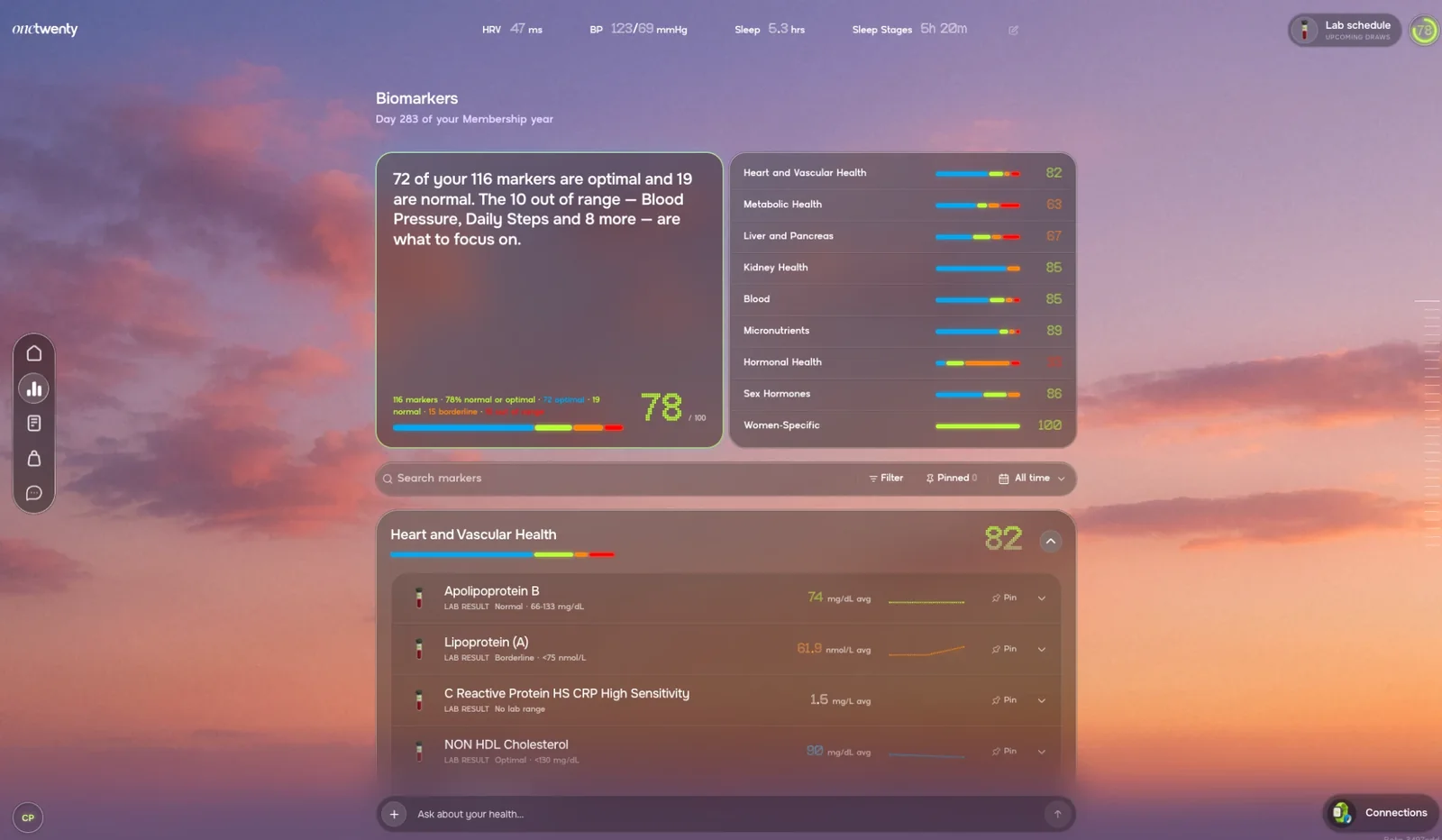
OneTwenty’s member dashboard puts your labs, your devices and your next step on one screen. Your latest device readings run along the top of every page (heart rate variability, blood pressure, sleep and sleep stages), beside your lab schedule and overall health score.
- Your markers in one read. The biomarkers page opens with a plain-English summary of how many results are optimal, which are out of range and which to focus on first, then scores each body system, from heart and vascular health to hormones and micronutrients.
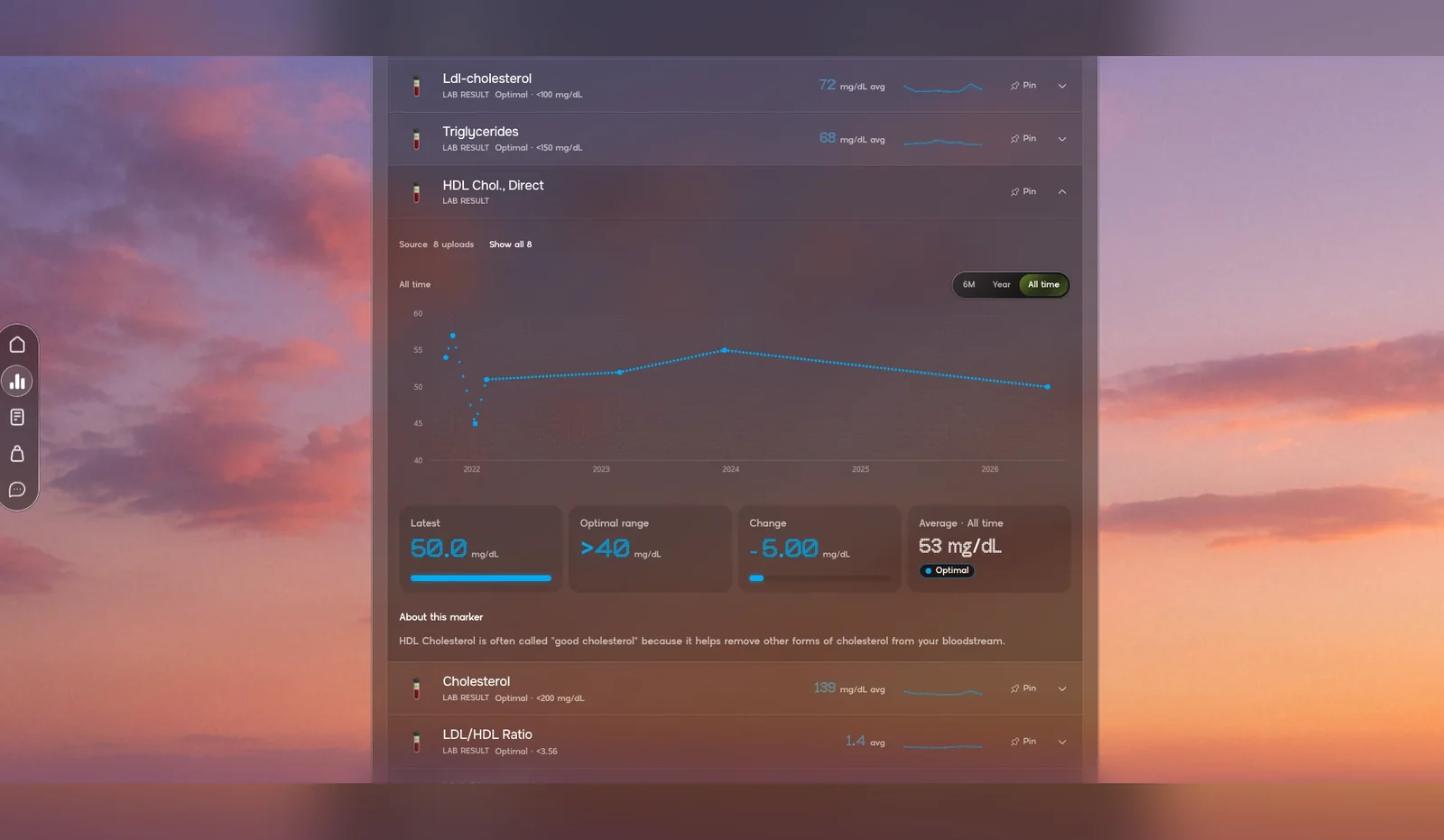
- Every result on one chart. Open any marker and its full history sits on a single timeline, older lab reports you upload included, with the optimal range, the change since your last draw and a short note on what the marker means.
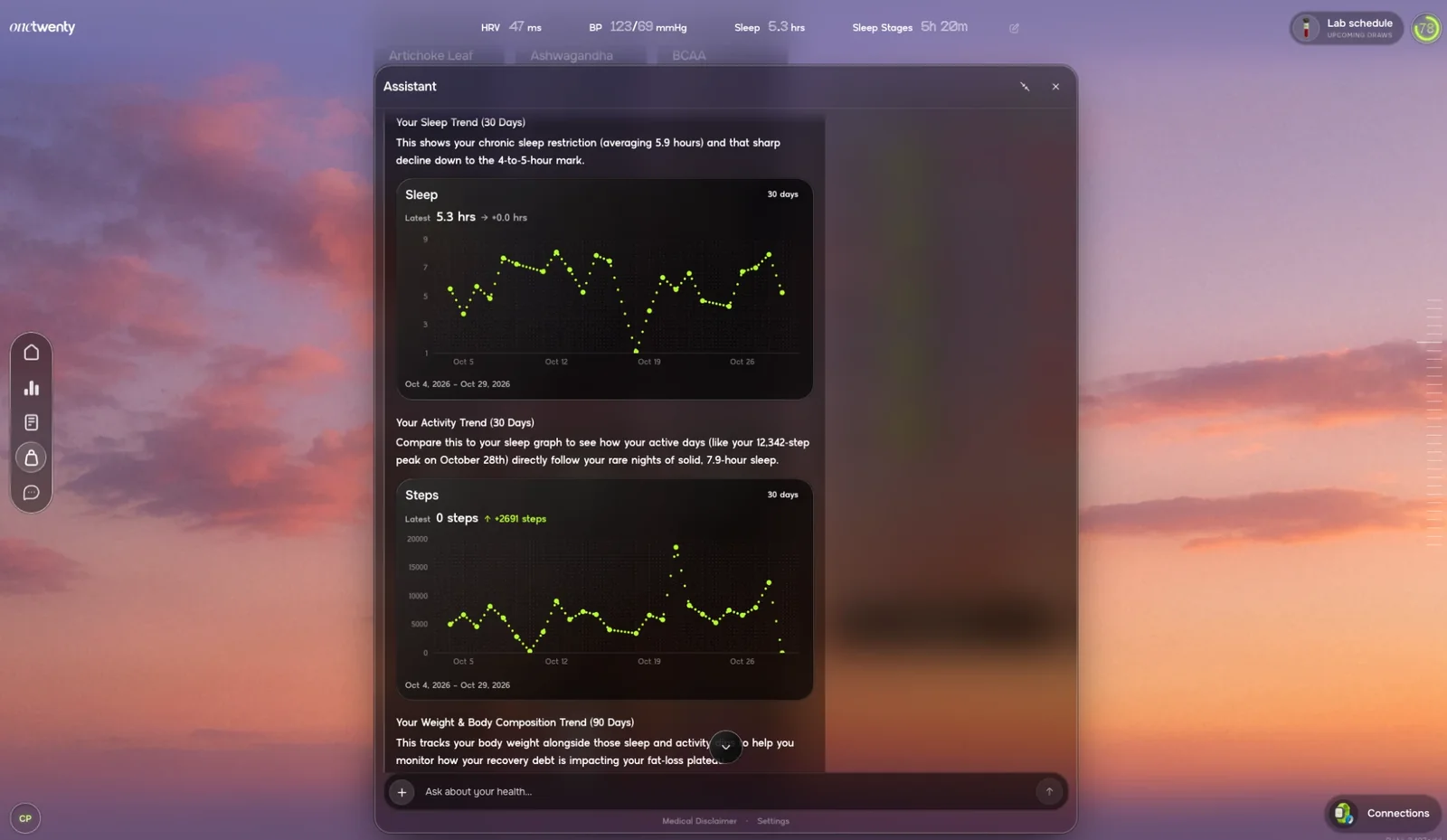
- An assistant that answers with your data. Ask a question from any page and it replies with your own charts, such as a month of sleep set against a month of steps, and explains how the two connect.
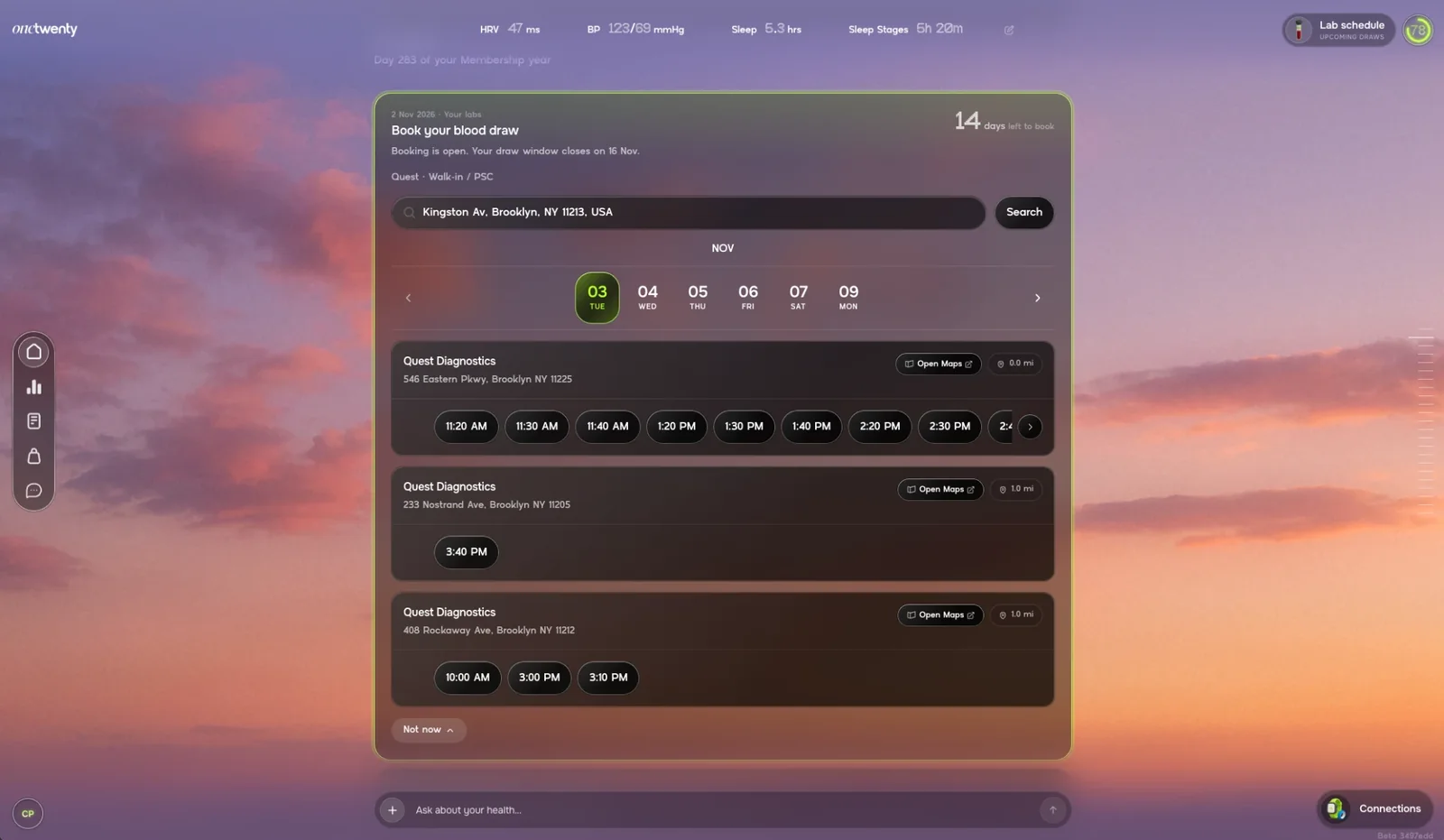
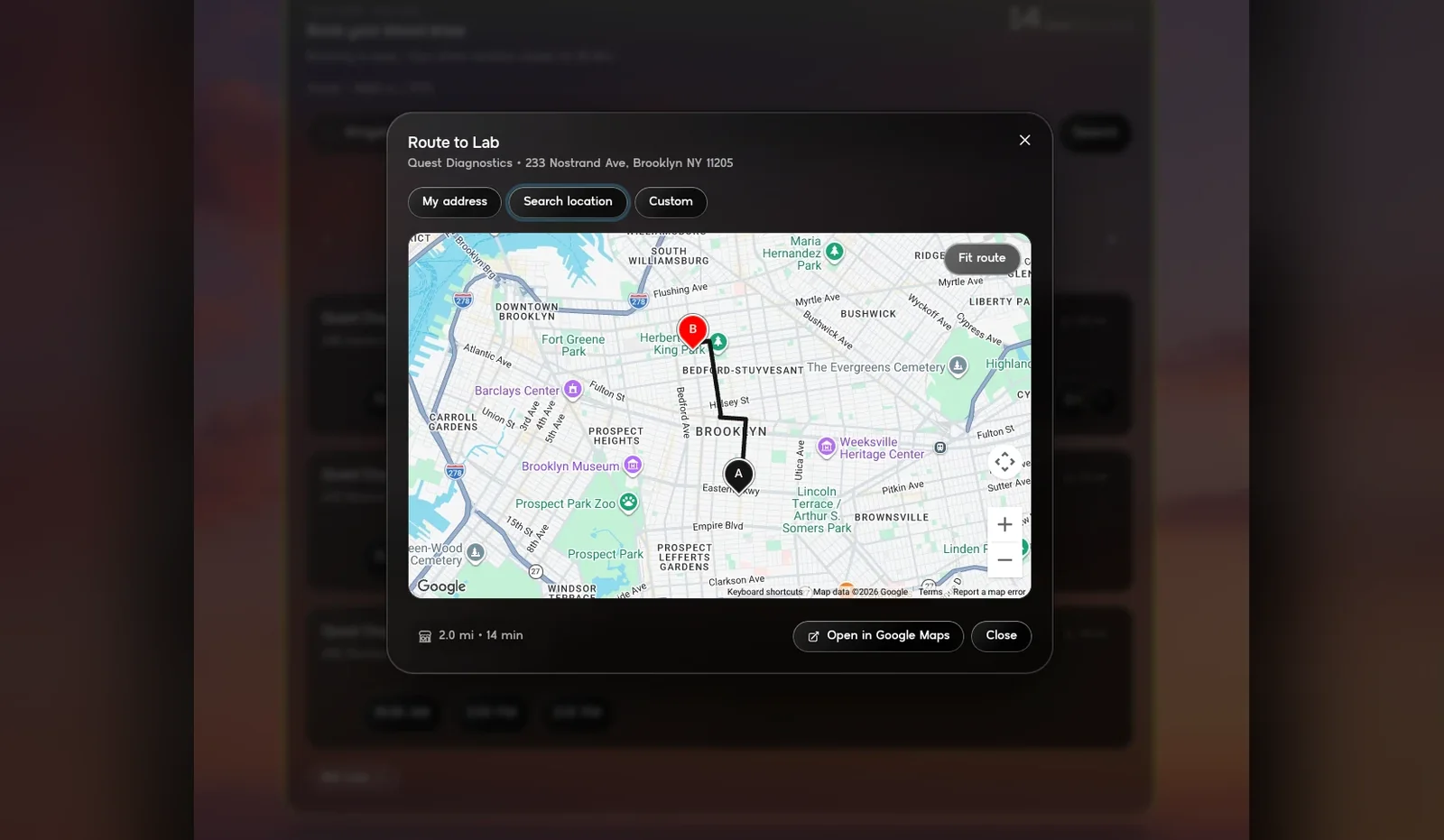
- Booking built in. When a draw is due, the dashboard counts down the days left to book, lists nearby lab locations with open times and maps the route.
Peptides at OneTwenty
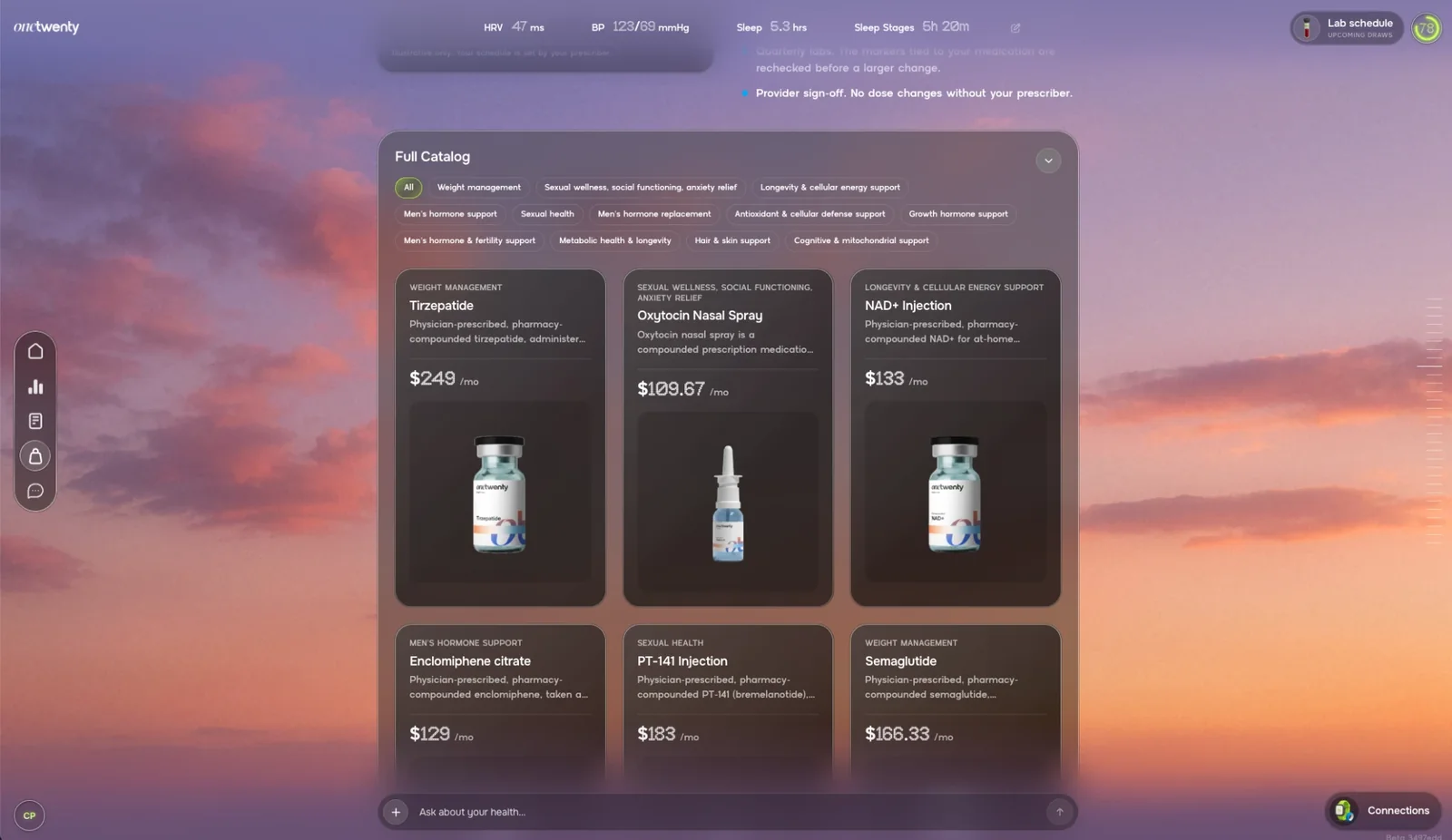
Peptides are short chains of amino acids, the building blocks of proteins, and several are prescribed as treatments. The GLP-1 medications semaglutide and tirzepatide are peptides. OneTwenty’s catalog also carries the ones below, each physician-prescribed and prepared by a licensed U.S. compounding pharmacy, and only after an independent licensed provider has reviewed your labs.
- Sermorelin. A growth hormone releasing hormone analogue that prompts the pituitary to release more of your own growth hormone rather than replacing it. OneTwenty offers it for lean muscle, recovery and sleep.
- PT-141 (bremelanotide). Acts on melanocortin receptors in the brain and is prescribed for low sexual desire and arousal.
- GHK-Cu. A copper peptide in a cream, applied to the skin for appearance and repair.
- Oxytocin nasal spray. A peptide hormone involved in bonding and social connection. Research on it for social anxiety is mixed, so it belongs alongside anxiety treatment, not in place of it.
Every peptide runs on the same loop as the rest of the membership. Your labs set the baseline, your device data fills the gaps between draws, and the markers tied to the medication are rechecked at your quarterly labs before any larger dose change. Nothing changes without your prescriber, and you are not charged until a clinician approves the treatment. Compounded medications are not FDA-approved, which means the FDA does not review them for safety or effectiveness before they reach you, so ask your provider what the evidence shows for anything you start.
Sign Up for OneTwentyFunction Health vs OneTwenty
| Feature | Function Health | OneTwenty |
|---|---|---|
| Annual price | $365 ($600+ in NY/NJ) | $499 ($749 in NY/NJ) |
| Testing frequency | 2x / year | 4 draws / year: 1 full, 3 targeted |
| Lab tests | 160+ / year (100+ then 60+) | ~200 / year (95+ at the full baseline, then 20 to 40 at each follow-up) |
| Wearable / device data | Limited (device context for AI) | ✓ 22 daily device metrics |
| AI coaching | Private AI Chat (beta) | ✓ 24/7 coach across labs + wearables |
| Supplement protocol | Generic suggestions | ✓ Matched to your labs from 60+ options, re-cut quarterly Bought separately; formulated packs ship Aug 2026 |
| Prescriptions | No | ✓ 15 treatments via licensed clinicians |
| Protocol updates | Semi-annual | ✓ Every 90 days |
| HSA / FSA eligible | ✓ | ✓ |
How Function Stacks Up Against Other Platforms
Function Health is one of several strong testing platforms. If you are weighing it against the other big names, these head-to-head breakdowns go deeper on price, biomarkers, and what each one actually does with your data.
Function Health Review: Frequently Asked Questions
Is Function Health worth it?
For broad, early-detection bloodwork, yes. Function tests 160+ markers a year for $365, with clinician notes and a clean dashboard, which is far more than a routine physical covers. It is less worth it if your goal is ongoing optimization, since it tests only twice a year and does not deliver supplements or prescribe medication. In that case a continuous platform like OneTwenty fits better.
How much does Function Health cost in 2026?
Function Health is $365 per year nationally, down from $499. Residents of New York and New Jersey pay more, often $600 or more, due to state lab regulations. Optional add-ons like the Annual MRI (around $899) and multi-cancer screening are billed separately. The membership is HSA and FSA eligible.
Is Function Health legit?
Yes. Function Health is a legitimate company founded in 2022 by Dr. Mark Hyman and Jonathan Swerdlin, with testing run through CLIA-certified Quest Diagnostics labs and results reviewed by clinicians. The question is not whether it is real, but whether its twice-a-year testing model fits how you want to manage your health.
How many biomarkers does Function Health test?
Function tests 160+ lab markers across a year: 100+ at your first annual draw, then 60+ at a follow-up three to six months later. You can also order additional biomarkers on demand at a member price.
Is Function Health HSA or FSA eligible?
Yes. Function Health membership is generally HSA and FSA eligible, so you can usually pay with pre-tax dollars. It is not billed through insurance, but members receive an itemized receipt for reimbursement. Eligibility depends on your specific plan.
Does Function Health cost more in New York or New Jersey?
Yes. Because of state lab regulations, New York and New Jersey residents pay noticeably more than the $365 national price, often $600 or more. If you live in either state, factor that in before subscribing.
What is the best Function Health alternative?
It depends on what you want. For continuous optimization with a full panel plus three targeted follow-ups a year, lab-matched supplement guidance, and prescription access, OneTwenty is the alternative I switched to. For deeper genetics, InsideTracker. For the lowest entry price, Superpower. See the Superpower and InsideTracker comparisons for details.
How does Function Health compare to Superpower and InsideTracker?
Function tests the most blood biomarkers and is built for early detection. Superpower is the cheapest entry point with care-team access. InsideTracker adds DNA analysis and a biological age score. OneTwenty goes furthest on continuous monitoring and acting on results. Our full Function vs Superpower and InsideTracker guides break it all down.
Final Verdict on Function Health
Function Health is a genuinely strong testing platform. The biomarker breadth is excellent, the Quest logistics are painless, the clinician notes are useful, and the 2026 upgrades, a lower price, AI Chat, Protocols, and a biological age score, make it better than it was at launch. If what you want is the widest possible look at your bloodwork twice a year, it earns its place.
My issue was never the data. It was that the data sat there waiting for me to act on it, twice a year, with no protocol built off it and no way to treat what the labs found. That is why I switched to OneTwenty, which runs a full panel and three targeted follow-ups a year, monitors my wearables continuously, builds my supplement protocol off my actual results, and connects me with prescriptions when my labs call for them, adjusting the plan every 90 days. If you want a health system rather than a health report, that is the difference that matters.
Want optimization, not just a twice-a-year report?
OneTwenty combines one full lab panel and three targeted follow-ups a year, daily wearable monitoring, a 24/7 AI Health Coach, a lab-matched supplement protocol, and prescription access in one membership, with your protocol adjusted every 90 days.
Sign Up for OneTwenty